
The Student PostDoctoral Affairs Committee (SPDAC) brings together student and postdoctoral leadership across all SICB divisions. This committee consists of appointed student or postdoctoral representatives from each SICB division and a chair appointed by broader SICB leadership. SPDAC works to improve student and postdoctoral experiences within and outside of SICB membership through student and postdoc-led support, change, resources, and initiatives. Learn more about SPDAC projects and committee members below.
-
- Student/Postdoctoral Affairs Committee (SPDAC) Mission and Guiding Principles:
- Undergraduates, post-baccalaureate researchers, graduate students, and postdoctoral researchers make up more than 60% of SICB membership. The Student/Postdoctoral Affairs Committee (SPDAC) is the official representative body of these student and postdoc communities within SICB.
- SPDAC’s mission is to advocate for and raise awareness of the needs of our student and postdoctoral members. We strive to promote belonging and inclusiveness, community building, educational improvement, and professional and career development for all early career members of the Society.
- Student/Postdoctoral Affairs Committee (SPDAC) Mission and Guiding Principles:
What does SPDAC do?
- Plan a professional development workshop at the Annual Meeting.
- Host an informational booth at the Annual Meeting.
- Run the New Student Orientation at the Annual Meeting.
- Organize social events for student and postdoc members at the Annual Meeting.
- Assist with planning events at regional SICB conferences throughout the year.
- Facilitate virtual working groups on topics such as applying for academic jobs throughout the year.
- Participate in monthly planning meetings together with the committee chair.
- Help guide SICB towards a vision of the society that fits SPDAC’s 2024 Strategic Plan to better serve its student and postdoc members.
- Student members of SPDAC also serve ex officio (as non-voting members) in Divisional Executive Committee meetings.
How can you get involved in SPDAC?
If you are a current graduate student or postdoc and are interested in serving as your division’s Student/Postdoc Representative, please reach out to your divisional Executive Committee and let them know! Members serve 3 year terms, or until they are no longer a student or postdoc, so positions often open up each spring or summer. You can contact the committee chair via the email address listed below.
Members
Contact the committee chair via chair.spdac@sicb.org
The committee consists of a chair, who is a Full Member of SICB and who is appointed by the President for a term of three years; the committee chair is a member of the SICB Executive Committee and an ex officio member of the Broadening Participation Committee. In consultation with each Division, the President appoints a Student or Postdoctoral Member to represent the Division; the terms of appointment are flexible but not more than three years.
-SICB Bylaws, Article XV, Section 7.
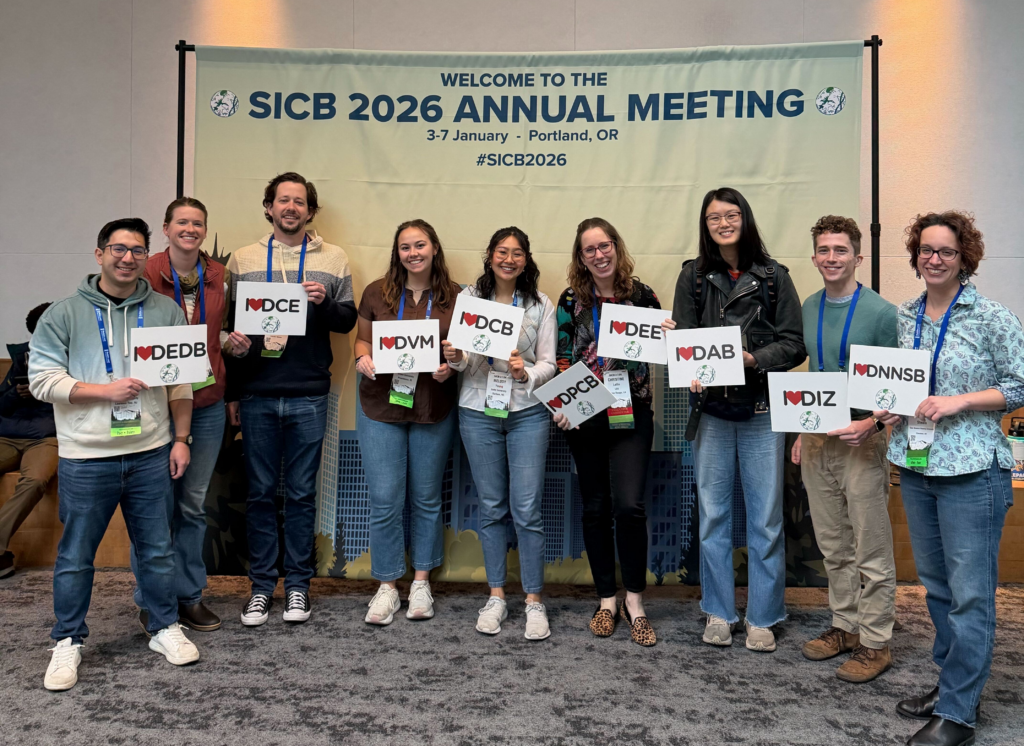
Not present in the photo: Ogonna Eli, Zehua Zhou
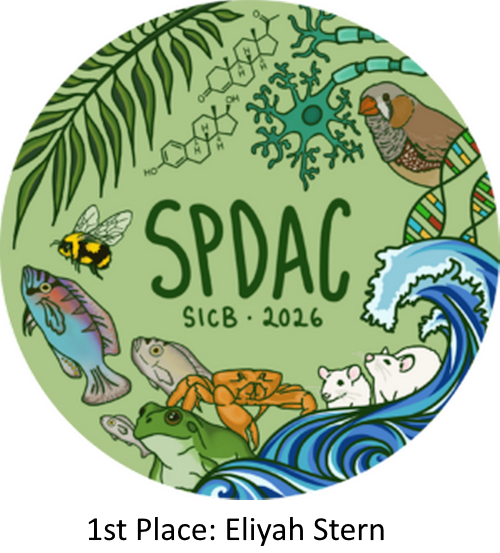
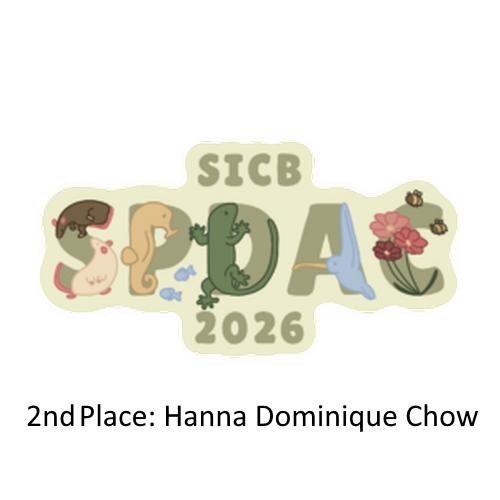
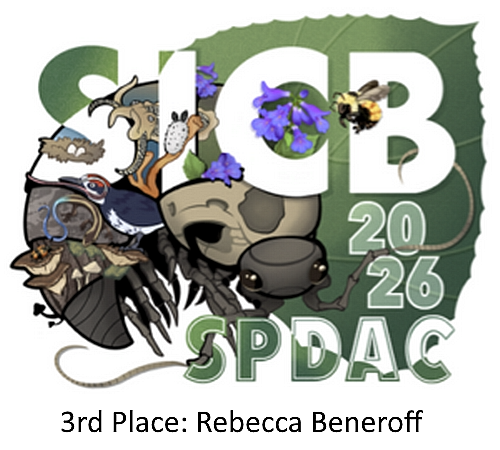
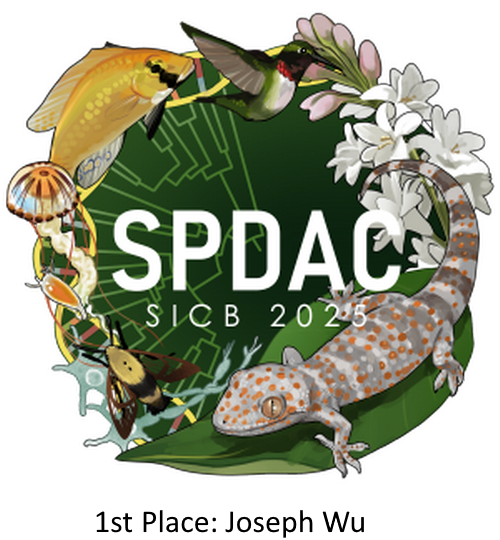
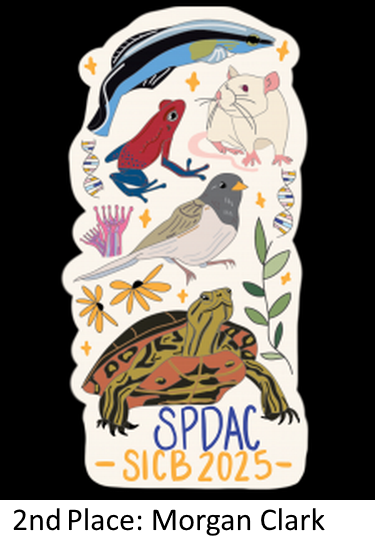
Stickers Competition
- First place: $100
- Second place: $50
- Third place: $50
2026 Winners
2025 Winners

Frequently Asked Questions
What should I do to prepare for my first SICB meeting?
Because there are multiple concurrent sessions, it’s best to plan ahead so you don’t miss a talk or session you really want to attend. Start with the meeting program; it’s posted on the SICB meeting website several weeks ahead of the meeting. There is also a meeting app you can use to help plan your schedule. But also be open to plans changing; if you get into a really fascinating conversation with a prospective future mentor, it’s probably better to miss a talk than to cut off what could turn into a future collaboration opportunity!
The division(s) you join determines which Best Student Presentation competition you are eligible for, so choose a divisionary “home” that fits your work, and browse past meeting abstracts if you aren’t sure. Finally, have a one-sentence answer ready for “what do you work on?” You’ll be asked constantly, and “I’m an undergrad who just started in a lab studying X” is a perfectly good answer.
How does the meeting mentoring program work?
Currently, each division runs its own mentoring program, and you can sign up during early-bird registration. Programs may be decentralized, where you are matched with a mentor, or centralized, where you will meet with a larger group at the conference. Some larger divisions have limited space, so make sure you watch your inbox after registration ends. If you have questions about your division, you should contact your SPDAC rep.
How do I find student/trainee-specific events and programming at the annual meeting?
Committee and business meetings, socials, and workshops are listed in the Schedule of Events on the meeting website, in the app, and in the paper program. Look for events hosted by SPDAC.
Recurring offerings include the First-Timer/Postdoc Welcome and Orientation; the SPDAC booth in the poster hall staffed by SPDAC members available for career advice and research conversations; SPDAC workshops (past topics: science communication, non-academic careers, writing accountability); and the end-of-meeting society-wide social. Programming changes yearly, so check the current program.
Prioritize: (1) your own division’s sessions, where you’ll see the closest work to your own and start recognizing names; (2) one symposium outside your area; symposia are theme-organized and published in Integrative and Comparative Biology, so they’re a great crash-course in an unfamiliar field; (3) poster sessions, which are better for conversation than talks and easier to follow up on if you go early; (4) plenaries, broadly pitched and widely attended, so they give you shared hallway material; and (5) at least one social or trainee event.
Don’t try to fill every minute of every day! If you are feeling tired or overwhelmed, it’s ok to take a break to go for a walk, take a nap, or read a book.
How do I figure out what division I am in?
Your division is based on your research interests, and you can use it to find labs that work in similar areas.
- Animal Behavior (DAB): DAB highlights integrative research in the field of animal behavior, with members studying behavior in the context of neurobiology, endocrinology, physiology, evolution, and developmental processes. Work spans field and lab approaches across a wide range of taxa, and the division sits at the crossroads of several others, making it a good home if your questions about behavior span multiple levels of biological organization.
- Botany (DOB): DOB is one of SICB’s newest divisions, formed in 2019 to encourage the inclusion of plants in the study of comparative patterns and integration in biology. Members range from longtime SICB members interested in plants to plant biologists new to the society, and plant-focused work spanning physiology, development, biomechanics, and ecology is often presented in themed sessions alongside animal work rather than segregated by taxon.
- Comparative Biomechanics (DCB): DCB members study the physical principles governing how organisms function and how those functional systems evolve, integrating engineering, physiology, behavior, robotics, and evolutionary biology. Research in this division includes locomotion, feeding mechanics, material properties, fluid dynamics, and bioinspired design across a wide taxonomic range, including fossil taxa.
- Physiology (DPHYS): DPHYS integrates research in comparative physiology with endocrinology and biochemistry from the cellular to the organismal level. Members use interdisciplinary approaches to understand how different physiological mechanisms correlate with behavioral and ecological variables in both laboratory and field settings.
- Evolutionary Developmental Biology (DEDB): DEDB members study organisms from annelids to zebrafish and levels of organization from cells to whole animals, using development as a lens for understanding evolution (“Evo-Devo”). Members often work comparatively across multiple systems (classic examples include Hox genes, fruit fly segmentation, and somite addition in chick) combining benchwork with sequencing-based computational approaches.
- Ecoimmunology and Disease Ecology (DEDE): DEDE is broadly interested in the interaction between hosts and their microorganisms: from parasites to mutualists, pathogens to microbiomes. Members integrate a broad range of methods to study immunology in a wide variety of non-model systems, the ecology of infectious diseases, and the microbiome, and we welcome anyone interested in studying immunology, disease ecology, or symbiosis.
- Ecology & Evolution (DEE): DEE is interested in understanding how organisms are influenced by their environment and evolutionary history. Research in this division spans nearly every level of biological organization, from genes to ecosystems, and uses a wide range of systems to unravel ecological and evolutionary mysteries.
- Intertebrate Zoology (DIZ): DIZ focuses on animals that lack a backbone. The types of research conducted by DIZ members is diverse, including ecology and evolution, biomechanics, phylogenetics, development, molecular biology, and physiology.
- Neurobiology, Neuroethology, & Sensory Biology (DNNSB): DNNSB focuses on the neural basis of behavior, neuroscientific mechanisms, and how nervous systems integrate sensory information. Members work with a wide variety of animals, from cnidarians to chordates, and use methods including behavior, neuroanatomy, histology, immunohistochemistry, and electrophysiology.
- Phylogenetics and Comparative Biology (DPCB): DPCB is about “tree-thinking”: our questions range from how to build a phylogenetic tree using morphological or molecular evidence to how to use the trees we build to answer evolutionary questions. Members develop and apply comparative methods such as testing for correlated trait evolution, reconstructing ancestral states, and estimating rates of diversification.
- Vertebrate Morphology (DVM): DVM evaluates how vertebrate anatomy relates to animal function. Research in DVM embraces and develops new experimental, imaging, and modeling techniques to enhance our understanding of vertebrate morphology in an interdisciplinary manner.
How do I get involved with my specific division?
Go to your division’s members meeting (some still call it the business meeting). It’s a chance to meet fellow members, learn how the division works, and find ways to engage, and members and prospective members at all career stages are welcome. Nobody will make you speak; sitting in the back and listening is a normal way to attend your first one. Division socials are more informal and often the easiest place to meet people working on questions close to yours.
If you are a grad student or postdoc interested in serving as your division’s Student/Postdoc Representative, contact your divisional Executive Committee. Terms run three years or until you’re no longer a student or postdoc, so spots often open in spring or summer.
Can I be in multiple divisions at the same time?
Yes! However, you can only compete in the Best Student Presentation session for one division. Similarly, if you want to participate in the mentoring program offered at the annual meeting (see above), you will have to choose your top two divisions. You will have a mentor matched with you based on your first or second choice of divisions.
Is there a dress code for the meeting?
No. You’ll see everything from jeans and a t-shirt to a full business suit. Presenters often dress up a bit, which might include a nice shirt or sweater and a pair of dress pants or khakis, but business attire isn’t expected. Wear clothes that make you feel comfortable and confident. Make sure you wear shoes you can stand in for a two-hour poster session, and bring a layer in case the building is chilly.
Everyone seems to already know each other; how do I break in?
Almost everyone feels this at their first meeting, including people who now look like they’ve known everyone forever. SICB is large, but it is also one of the friendlier societies in the field, and most people love talking about their work with someone who’s curious.
Some things to try:
- Chat with people standing next to you in line. At a big conference like this one, you will wait in lines for registration, coffee, and snacks. Just a smile and an icebreaker question like “have you been to SICB before?” or “did you hear any interesting talks this morning?” can lead to a great conversation.
- Don’t skip the poster sessions. Poster sessions literally exist so people can walk up to strangers and ask questions! Walking up to a poster isn’t an interruption, it’s what the presenter is there for. “Can you tell me about your project?” is a great opening.
Talk to other trainees first. They’re in the same position as you, and these are the people you will still know in ten years. The SPDAC booth and First-timer Welcome Session can help you meet other students and postdocs.
Follow up after talks. “I saw your talk yesterday and had a question about X” is much easier than starting from nothing, and speakers are usually pleased someone was paying attention. - Go to your division’s events. A division social is a smaller room full of people who work on things similar to you, which is a far easier place to start than a general reception.
- It’s fine to leave a conversation. “It was nice to meet you, I’m going to grab a coffee” is a normal, non-rude exit. Knowing you can leave makes it easier to start.
- Also be sure to sign up for the Meeting Mentorship Program, which will give you at least one friendly face at the meeting.
Can students publish in or review for the SICB journals?
Yes to both. Integrative and Comparative Biology (ICB) publishes peer-reviewed integrative, comparative, and organismal work, including symposium proceedings from the annual meeting plus reviews, syntheses, and empirical articles selected by the editorial board. If you are invited to speak in a SICB symposium, an ICB paper typically comes with it, and can be a common route to a first publication.
Integrative Organismal Biology (IOB) is a fully open-access journal that publishes original data articles, opinion pieces, and letters. IOB uses double-blind peer review and an explicitly constructive review process, which makes it a friendly place for a first submission. Nothing excludes students from submitting, and IOB now gives a Best Student Paper Award.
For reviewing, the usual route is to tell an advisor or mentor you are interested in co-reviewing with them! You will both write a review of a paper, and when your advisor or mentor submits the review they should tell the editor you contributed.