
For any child growing up visiting national parks or camping with their family, the phrase “only YOU can prevent wildfires” is ingrained in their consciousnesses.
However, despite Smokey the Bear being the face of wildfire prevention nationwide, scientists know shockingly little about how wildfire impacts animals. The wildfire smoke, which Smokey is named after, can travel thousands of miles and impact the air quality of areas far from the actual fire. How does this change in air quality impact animals that cannot simply put on a mask or stay indoors? Dr. Jamie Cornelius, an associate professor at Oregon State University, is one of the scientists seeking to answer this question, focusing on birds as a study system.
Birds are especially sensitive to air pollution; their ultra-efficient breathing anatomy that allows for flight means that they can be heavily impacted by any particles in the air. This adaptation likely means birds are among the most vulnerable taxa to wildfire smoke.
However, wildfires are not new phenomena: birds likely co-evolved with fire and have developed behavioral and physiological strategies to minimize impacts on their health. Dr. Cornelius and her lab members aim to learn more about these strategies, and a recent study funded by the National Geographic Society took another step towards understanding how birds respond to wildfire. In a dry pine forest nestled in central Oregon, Dr. Cornelius went to work capturing birds to measure responses to smoke from the 2023 fire season.
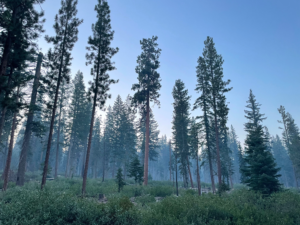
In these forests, wildfires are becoming a near-annual occurrence. The five largest wildfires in Oregon’s recorded history have occurred since the turn of the century. Just last year, in 2025, the Cram Fire burned almost 100,000 acres in central Oregon, directly following a 2024 season of five “megafires” (those that burned 100,000 acres or more). This regularity of fires makes these sites the perfect candidates for natural experiments, and the increasing intensity highlights the need to do so.
Using both radio telemetry and physiological assays, Cornelius and her team sought to test multiple theories on how birds are adapted to deal with smoke. Do birds simply fly away from smoky areas, do they hunker down and hide, or can they cope physiologically despite the smoke-filled air? In short: How do birds respond to smoke? Fight or flight?
They fit American robins (Turdus migratorius) with GPS tags prior to the dry season to see how their migrations would be impacted by smoke. The robins didn’t fly away from the fire; their migratory patterns seemed unaffected by smoke. However, it is worth noting the highest levels of smoke weren’t reached in 2023, leaving the possibility open that migration patterns may change in years with higher-intensity fires.

Beyond migration patterns, Dr. Cornelius sought to measure various physiological responses of multiple songbird species, including muscle size, blood sugar levels, and circulating stress hormone levels. Do birds have ways to “fight” the fire? The jury is still out: while some species appear to show lower blood sugar levels and worse body conditions in response to smoke, many of these results are still preliminary and require more investigation.
“You just have to keep trying; keep chipping away,” Dr. Cornelius notes, a sentiment all field scientists are familiar with. Especially in an environment as variable as an active wildfire, getting the data is a constant struggle.
Dr. Cornelius acknowledges the challenges of collecting data on wildfires “It’s risky, to some extent.” These challenges may be a major factor in our lack of understanding of the impact of smoke on wild animals. Observational data can be difficult to collect when it involves walking head-first into a wildfire or a heavy smoke area; simply sitting and watching how birds respond to increased smoke is nearly impossible.
Despite the risks, fire ecology is a growing field as concerns about a changing climate leading to longer and more intense fire seasons rise. If a baseline understanding of animals’ response to fire doesn’t exist, figuring out how organisms will respond to a changing fire regime will be impossible. “In the last five years, there has been way more [research done on fire responses] than the past 200” Dr. Cornelius notes, and her lab and collaborators are a part of that surge in interest.
Dr. Cornelius believes that as fire comes into the forefront of everyone’s mind, the opportunity for increasing scientific understanding may expand. Fires can be unpredictable and sudden; this makes planned experiments difficult but also means occasionally they could occur in the middle of unrelated fieldwork. If the importance of studying fire responses is well known, future researchers might be able to turn fires that could be catastrophic to a field experiment into an opportunity for data collection.
Why should researchers put the time and effort into studying fire responses, even though field work is difficult? Why should we care? Dr. Cornelius explains “We care because literally billions of organisms experience smoke on the globe”. Her work, and the continued work of others, will bring us closer to understanding how smoke and other impacts of wildfires shape the organisms around us in our changing world.
Author Bio:

Kathleen (Katie) Griffin is an undergraduate at Georgia Tech, graduating May 2026. She is currently working with Dr. James Stroud, studying intraspecific variation in habitat use in anoles. She will be starting a PhD in Ecology and Evolutionary Biology at Virginia Tech in Fall 2026, where she will study parental care in squamates with Dr. Jen Moss. When she’s not in the lab or field, she’s hiking, gardening, or watching bad reality TV with her friends.